Research
The best marketing channels for a small business, by industry: what 46 niches show in 2026
For most small businesses the channels that bring customers are Instagram, an email list and Google: Instagram is a core channel in 30 of the 46 niches we researched, an email list in 27, a Google Business Profile in 23 and search with a blog in 23. X is a core channel in one niche and Reddit in one. Which channels lead for you depends on how your buyers decide, so each niche has its own blueprint.
We researched 46 kinds of small business — from wedding photographers and dental clinics to indie games and investing apps — for the plans our studio writes. Each one became a public blueprint: the channels that carry the niche, what to post and how often, the season, the rules and the first 90 days, built from the platforms' own pages, industry surveys and practitioners' guides. This article is what the 46 have in common, and where they differ.
Which channels carry most small businesses
A channel is core in a niche when the research found that buyers in that niche actually decide there. Counted across the 46 blueprints:
| Channel | Core in | Support in | Leave for later in |
|---|---|---|---|
| 30 | 12 | 4 | |
| An email list | 27 | 15 | 4 |
| Google Business Profile | 23 | 7 | 16 |
| Google search and a blog | 23 | — | — |
| 8 | 11 | 27 | |
| YouTube | 8 | 28 | 10 |
| TikTok | 8 | 23 | 15 |
| 5 | 10 | 31 | |
| 5 | 25 | 16 | |
| 1 | 20 | 25 | |
| X | 1 | 5 | 40 |
Three things stand out. Instagram is where most small businesses are judged, but often not where they are found: it is the portfolio a buyer checks after a recommendation. An email list is core in more niches than any network but Instagram, because most purchases here take weeks of thinking. And Google — the Business Profile for anyone with a local customer, the blog for anyone whose buyers search a question — carries half the niches on its own.
Where buyers really come from, niche by niche
The averages hide the part that changes a plan. A few findings from the blueprints that generic advice gets wrong:
- Wedding couples pick a look before they pick a photographer. 77% of 2026 couples use Pinterest for inspiration and 50% use TikTok, up from 41% (Zola First Look Report). Instagram is where they check the portfolio after a venue or planner names you. The wedding photography blueprint builds on that order.
- Restaurants are found by people, not posts. US diners name word of mouth (38%), walking or driving past (30%), map apps (18%) and search engines (16%) as the ways they find a place, in Toast's 2025 survey of 1,466 adults (Toast). So the Google Business Profile and reviews come before the content calendar (blueprint).
- Real estate agents are chosen before the first call. 43% of buyers found their agent by referral and 18% used an agent they had used before (NAR's 2025 Profile, via Virginia REALTORS). Content works for an agent when it keeps the past clients' circle remembering the name (blueprint).
- January is smaller than it looks for gyms. It brings 10.6% of a year's US gym sign-ups, with a second, smaller peak in May (GymMaster 2025 survey). A trainer who only plans for New Year misses most of the year (blueprint).
- Software buyers start in a chatbot. 50% of B2B software buyers now begin their research in an AI chat instead of Google (G2, August 2025 survey of 1,000+ buyers). Honest comparison pages and reviews do more for a small tool than a launch-day spike (blueprint).
- Tour operators beat the big booking sites in AI answers. In Google's AI Mode, people clicked the operators' own links 56% of the time and the booking sites under 10% (Propellic data, reported by Arival). An operator's own pages matter again (blueprint).
- Local recommendations now come from AI too. 45% of US consumers used ChatGPT or another AI tool for local business recommendations, up from 6% a year earlier (BrightLocal Local Consumer Review Survey 2026). What a business's profile, site and reviews say about it is what those answers repeat.
The rules that catch small businesses out
Every blueprint has a section on the rules of its niche, and a few come up again and again:
- Fake and bought reviews are illegal in the US. The FTC's rule bans fake reviews and testimonials, buying reviews and hiding negative ones, with civil penalties per violation (FTC, August 2024). Asking only happy customers is also out of bounds on Google.
- "Eco-friendly" needs proof in the EU. From 27 September 2026, generic environmental claims and claims of neutral impact based on offsetting are banned without proof (Directive (EU) 2024/825). It matters most to the fashion, beauty and handmade blueprints.
- Some professions may not collect testimonials at all. Psychologists may not solicit testimonials from current clients (APA Ethics Code, standard 5.05), so a therapy practice markets on education, directories and referrals instead (blueprint).
- Instagram takes five hashtags. Its Help Center now allows up to 5 on a post (Instagram Help). The old advice of 30 tags is out of date.
How to use a blueprint
Step 1
Pick at most two core channels
Start where your niche's buyers decide, not where you like to post. The rest wait until those two work.
Step 2
Follow the first 90 days
Each blueprint has the order a marketer who knows the niche would follow, week by week.
Step 3
Plan around the season
Engagement season for weddings, January and May for gyms, tax season for accountants: each blueprint has its calendar.
Step 4
Measure what the niche measures
Booked consultations, enquiries by source, saves and sends, not followers. Each blueprint names its numbers.
Find your niche
- Weddings and events: video production and videography, wedding photography, wedding planners and venues
- Creative studios: freelance web design, portrait, family and brand photography, architects and home builders, interior design, artists and illustrators
- Health, beauty and fitness: skincare and beauty salons, dental and aesthetic clinics, nutrition and healthy eating, fitness and personal training, physiotherapy, chiropractic and massage clinics, therapists and mental health practices, yoga and wellbeing
- Local and professional services: B2B consulting, home services and trades, lawyers and law firms, pet care and pet products, digital marketing for small business, accountants and bookkeepers, tutoring and kids' classes, real estate agents
- Shops and product brands: coffee roasters and small food and drink brands, handmade and craft shops, kids and baby products, supplements and wellness product brands, independent fashion brands, cosmetics and skincare product brands
- Food, drink and travel: hotels, B&Bs and vacation rentals, restaurants and cafes, travel experiences and tours, wineries, breweries and distilleries
- Software, apps and games: consumer mobile apps, AI tools and software for small business, AI music and video generation for YouTube creators, indie games and game studios, investing apps and tools for retail investors
- Creators, educators and causes: language learning and exam preparation, nonprofits and charities, personal finance education, podcasts and newsletters, authors and self-published books, online courses and coaching, musicians, bands and music producers, UGC creators and influencers
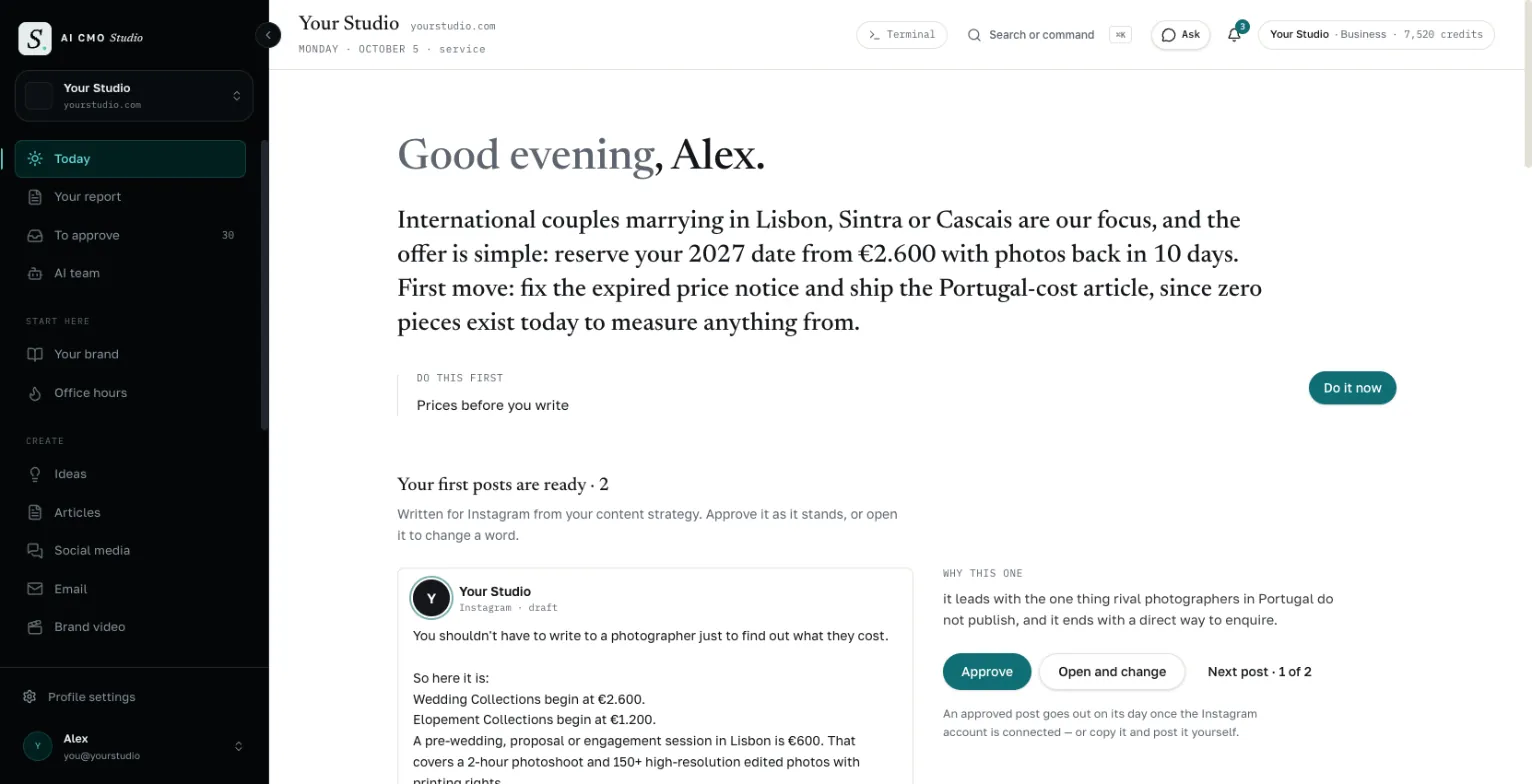
If you would rather have the plan worked for you: AI CMO Studio reads your site or profile, finds your niche's blueprint and drafts the month on its channels and season, and nothing goes out without your yes. The set-up is free.
Next step
See which questions your site loses, and to whom.
Run the AI Visibility CheckFree · no account · about 30 seconds
Written by Yana — Founder, AI CMO Studio. She runs the studio on her own websites first.
Last updated: 23 October 2026.
Questions
Asked about this one
What is the best marketing channel for a small business?
For most small businesses it is Instagram, an email list and Google: Instagram is core in 30 of 46 niches we researched, email in 27, the Google Business Profile in 23. The right one is where your buyers decide, so check your niche's blueprint.
Is X (Twitter) worth it for a small business?
Rarely as a main channel: X was a core channel in one of 46 niches (investing apps) and one to leave for later in 40. It suits founders whose buyers already talk there, such as finance and software.
Do small businesses still need a Google Business Profile?
Yes, for any business with local customers: it is a core channel in 23 of 46 niches. Google ranks local results on relevance, distance and prominence, including reviews, and AI answers now repeat what the profile says.
How many channels should a small business use?
Start with one or two core channels for your niche and add a support channel only when those work. A small team spread over five networks usually does all of them badly.